

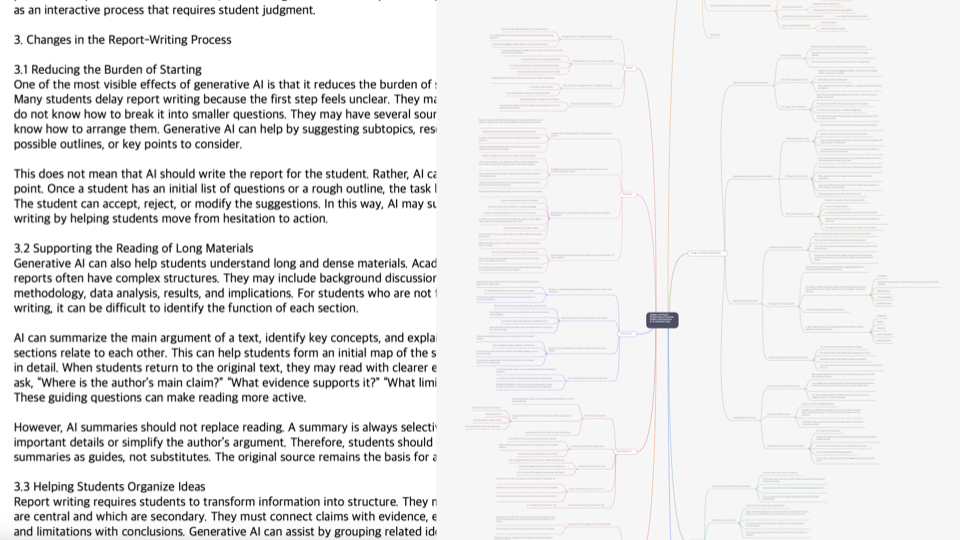
Why Structure Maps Are Needed to Work with Documents, Not Just Summarize Them
Long research papers and professional documents require more than summaries. From a Brify perspective, this post explains why structure maps matter for tracing arguments, evidence, logical flow, and source trace locations.
When reading long research papers or professional documents, quickly understanding the key points is not the same as actually working with the content. A summary can be a starting point, but researchers, paper writers, and readers of policy documents need more than that. They need to see how claims connect to evidence, where the logical flow changes between paragraphs, and exactly where cited source text appears.
Brify starts from this point. Instead of simply shortening long documents, it turns them into structure maps that preserve detailed information, making it possible to read, rewrite, and review the document again. Rather than scattering concepts the way a typical mind map does, Brify is designed so you can see what each item is based on, how the argument develops, and which parts matter most.
The advantages of this approach are clear. First, you can grasp the document at a glance without losing detail. Second, because you can trace back to the source trace from the structure map, you can immediately verify where the summarized information came from. Third, because the structure can be edited and shared, it is useful not only for individual review but also for team collaboration and report writing.
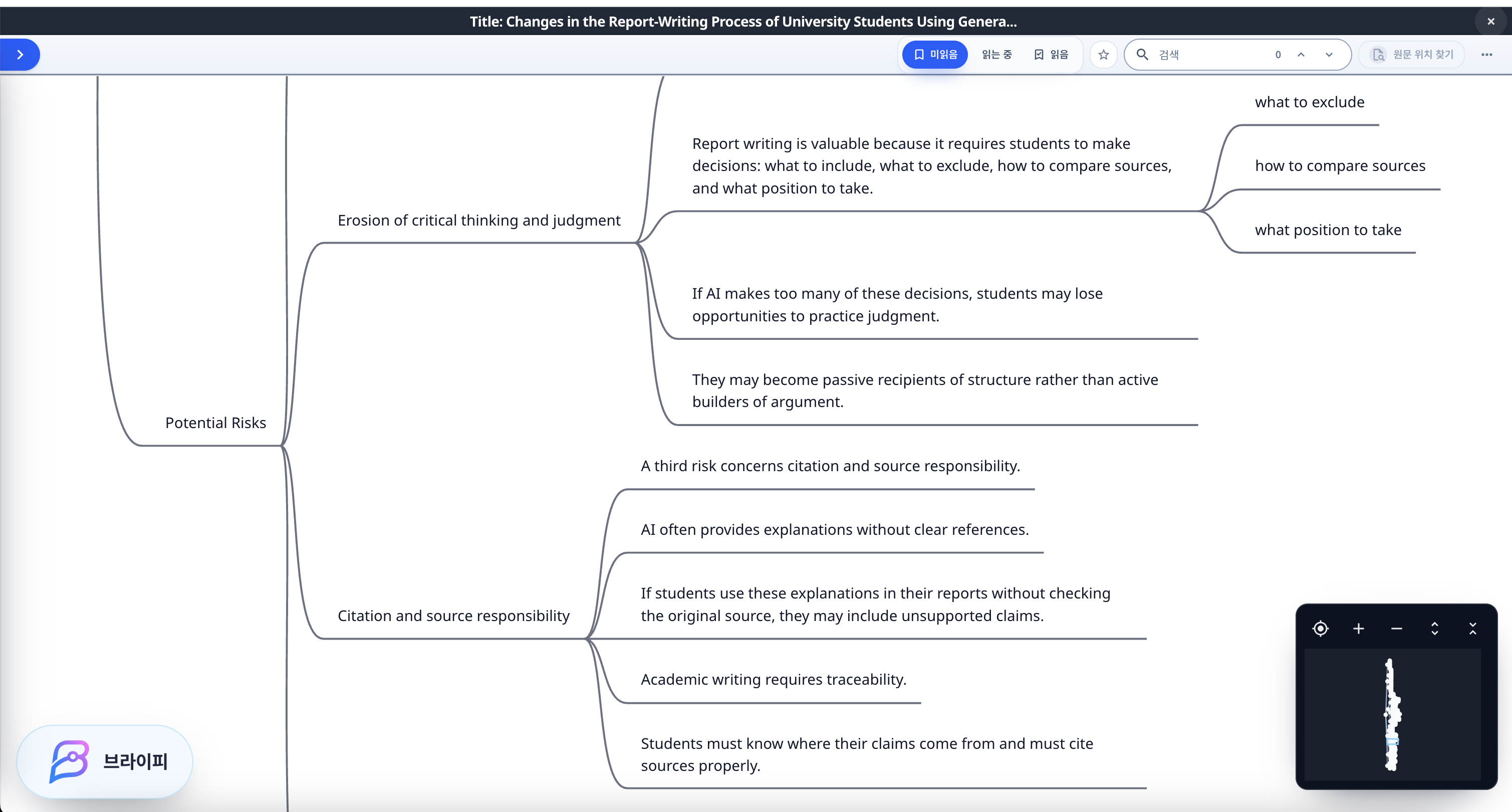
This is especially important in areas that generative AI often struggles to handle well in a single pass. The challenge is to preserve the context of an entire long document while keeping every detail intact and organizing it in a form that can be reviewed later. Brify focuses on turning this work into a document structure that can be kept, revisited, and continuously worked with, rather than a one-time output that is read once and forgotten.
In addition, the PDF download and slideshow features keep the structure map from being just a screen-based result. When needed, you can store it as a document, and when presentation or sharing is required, you can move it into another format and use it accordingly. This is especially useful for work that requires repeated handling of documents, such as research notes, research paper reviews, policy analysis, and professional report organization.
In the end, the important question is not “How much was it shortened?” but how accurately the structure was preserved. Brify turns long documents into a structure you can actually hold onto, then makes that structure editable, traceable, and shareable. If you want to organize documents into something you can work with in practice, not just summarize, a structure map may be the better answer.