

Why a Summary Alone Isn’t Enough: Researchers Need a Structure Map
Summaries are fast, but they often miss document structure and source trace. Researchers need a structure map that lets them revisit and verify the original text.
Reading a research paper is not simply about getting to the main points quickly. For researchers, graduate students, report writers, and people who work with research and professional documents, what matters is understanding the full structure, not missing important details, and being able to return to the original text when needed.
Summaries are clearly convenient. They help you quickly grasp the core claims and conclusions of a long document. But when you actually need to read, compare, and cite research papers, policy documents, or research reports, there are many moments when a summary alone is not enough. You also need to see the order in which the author develops the argument, which evidence supports which claim, and where important concepts first appear.
Summaries are fast, but they remove too much
AI summarization tools turn long texts into short ones. The problem is that in the process, the structure and context researchers need can disappear as well. The purpose of reading a research paper is not just to “understand what it says,” but to rewrite, compare, and verify it based on that content.
That is why researchers need structure, not just answers. They need to see the document’s overall flow, the main claim and supporting claims, evidence and examples, recurring concepts, and sentences that should be checked again—all at once.
A structure map goes deeper than a mind map
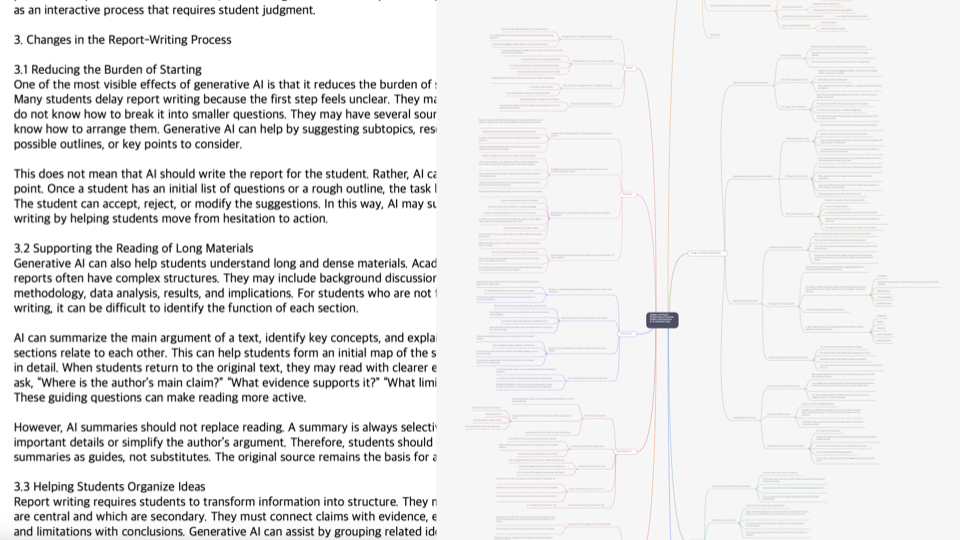
Brify is not just a mind map generator. The structure map Brify creates is an editable structure that organizes long documents into a readable form while preserving their flow, logic, and details as much as possible.
In other words, it is less about shortening a document and more about turning it into a form you can reread and use. You should be able to see the overall flow at a glance, keep important details as nodes, and drill down into the original text when needed.
You need to verify the source trace
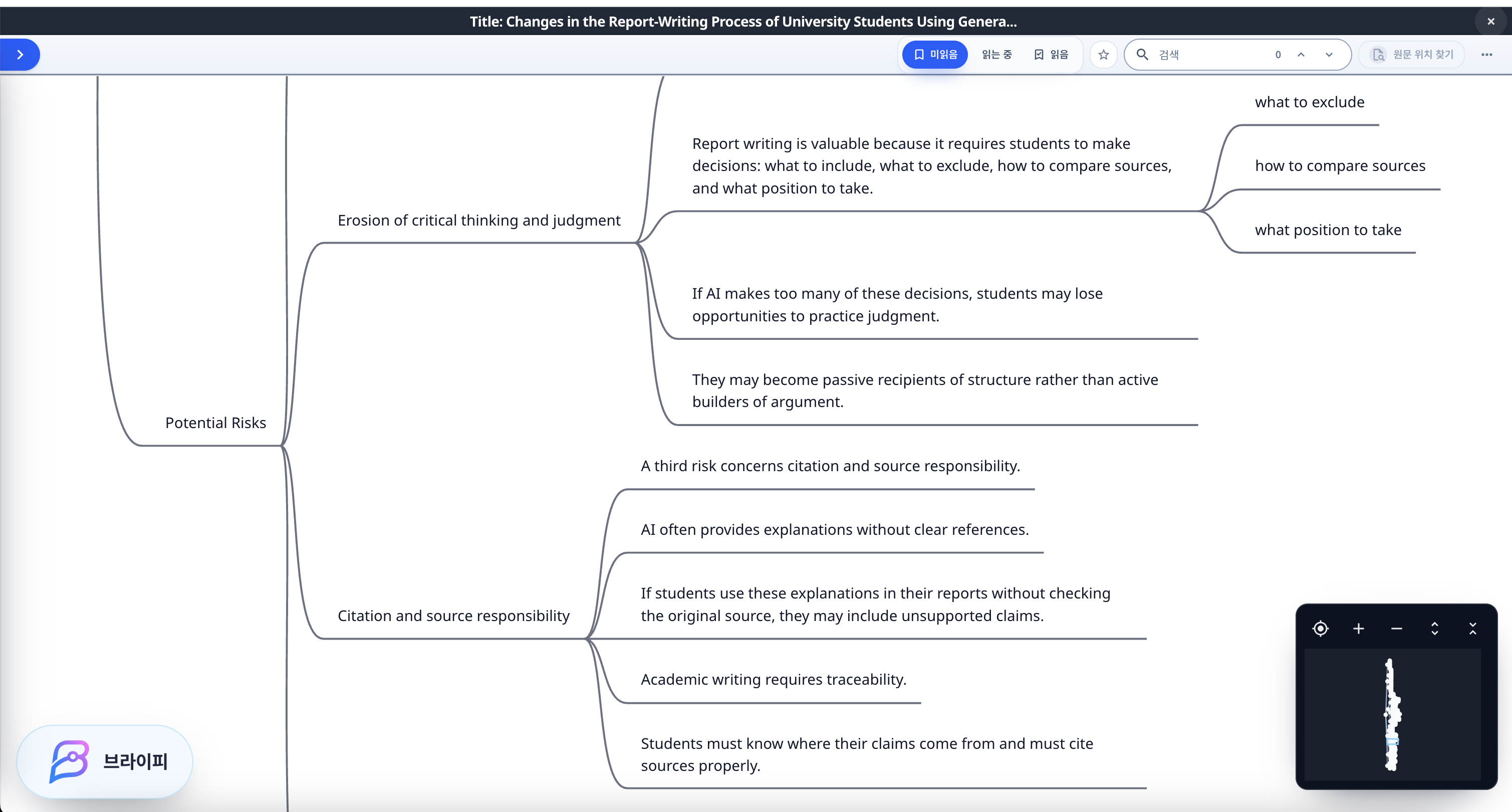
In research work, one of the most important things is the source trace. No matter how polished an AI-generated sentence looks, you still need to confirm whether it actually appeared in the original text, the context in which it appeared, and whether it is suitable for citation.
Brify connects structure map nodes to the original text, so users can move from a specific point back to the relevant source trace location right away. This is not just a convenience feature; it supports research work that values verifiable evidence.
A workflow for editing, sharing, and rewriting
A good document tool does not stop at reading. Users should be able to edit the parts they need while viewing the structure map, share the organized content, or download it as a PDF for reuse. If a presentation or review is needed, they should also be able to continue into a slideshow format.
The reason this matters is simple: researchers do not read a document once and finish. They read, mark up, compare, and reorganize repeatedly. Brify is designed to make that repetition less cumbersome.
What matters more than a summary is the ability to work with documents
Brify is not a summarization app. It is a tool that turns long research papers and research and professional documents into structure maps with detailed information intact. A summary can be a starting point, but researchers need what comes next: seeing the full structure, checking the details, returning to the original text, and reorganizing the material in their own words.
Brify’s role is to support that process more effectively.