

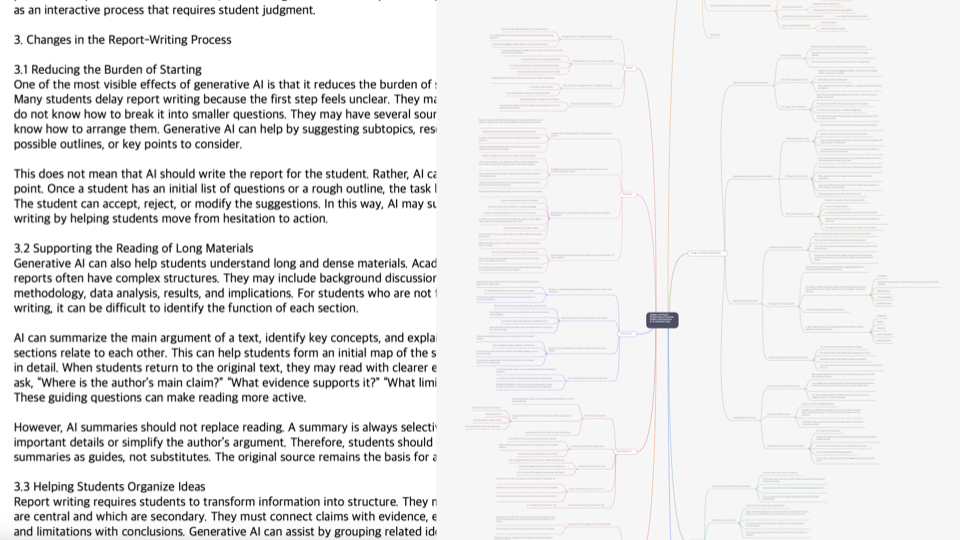
Why Professional Documents Should Be Structured, Not Just Summarized
An introduction to Brify’s approach: turning research papers and professional documents into structure maps that preserve detail and source trace, not just summaries.
Summaries of research papers are not enough. Researchers need structure maps
People who work with research papers, research reports, policy documents, and research and professional documents read a lot every day.
But the problem is not simply that they have to “read a lot.”
What is really difficult is keeping track of the flow, claims, evidence, examples, and detailed information inside long documents without losing anything important.
You may feel like you understood a text while reading it, but when it is time to write, this often happens:
- You start to forget the paper’s main argument.
- It becomes unclear which evidence supports which claim.
- The details were clearly important, but it is hard to find where they were.
- When you try to compare multiple documents, the structure falls apart in your head.
- The summary remains, but it is hard to check the original text again.
That is why we keep wishing for a tool like this.
A tool that structures long research and professional documents without losing detailed information.
A tool that lets you see the full flow at a glance while still returning to the source when needed.
Brify started from exactly this problem.
It is not a summarization app
There are now many AI tools that summarize long texts.
You can upload a research paper, get the key points organized, and even ask questions.
But for researchers, a summary alone is not enough.
A summary is convenient, but it often removes too much.
What matters in a research paper or research and professional document is not just a few lines of conclusion.
What researchers actually want to see includes things like:
- the overall structure of the text
- main claims and subclaims
- evidence and examples
- relationships between concepts
- detailed points
- sentences and phrases that should not be missed
- source locations that need to be checked again
Simple summaries often compress all of this into a single block.
But research and writing do not end with one compressed answer.
They require reading, comparing, checking again, and rebuilding the material into your own writing.
Why NotebookLM-style mind maps still feel limited
Tools like NotebookLM are clearly useful for researchers.
They help you ask questions, get answers, and quickly understand what a document is about.
But when it comes to the mind map feature alone, there are still limitations.
NotebookLM’s mind map is basically close to a summary.
Rather than carefully preserving detailed information and supporting close reading, it is closer to a light scan of the document’s major topics.
It also differs a bit from the workflow researchers actually need in practice.
- Editing the structure directly
- Adding or rearranging detailed nodes
- Saving it and returning to it later
- Jumping from a specific node back to the source
- Refining the structure so it can be used for a literature review or report
What researchers need is not just a mind map image.
They need a high-quality structure map that preserves detailed information and can be worked with over time.
That is why we use the term “structure map”
Brify is not just a mind map generator.
We felt that the word mind map alone could not fully describe what Brify is trying to do.
So we use the term structure map.
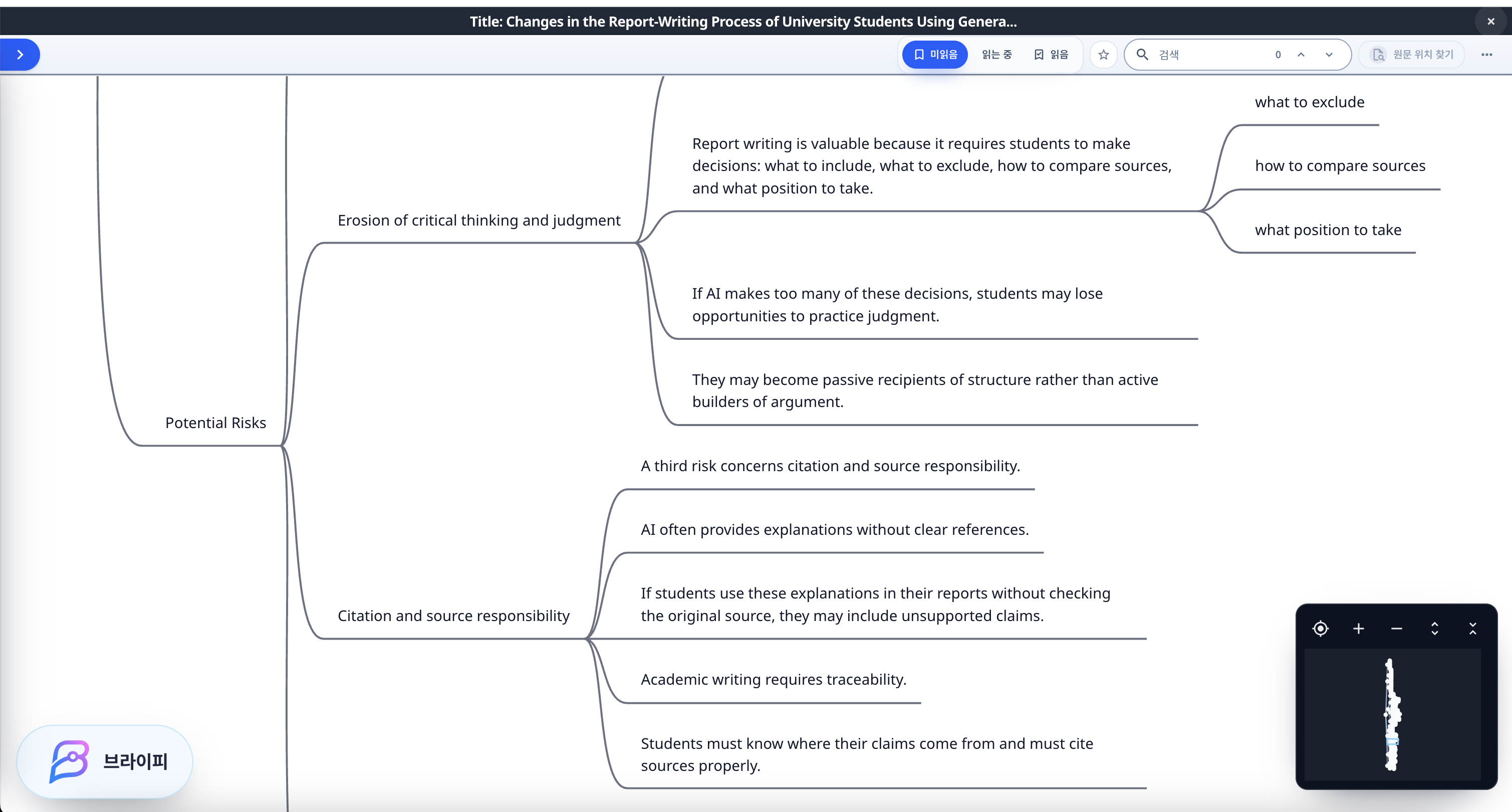
A structure map is not just a neatly branched picture of a long document.
It is a workable structure that captures both the document’s logic and its detailed information.
Brify’s structure map is designed to do the following:
- Show the overall flow at a glance.
- Preserve important details as leaf nodes.
- Group too many leaf nodes under meaningful units to make reading easier.
- Keep source trace together with the content.
- Let users edit and reorganize it directly.
- Make it possible to reopen it later and use it for research and writing.
In other words, a structure map is not a summary output.
It is a working artifact that turns a long document into something researchers can actually handle.
You need to be able to return to the source
When reading research papers and research and professional documents, one of the most important things is the source text.
Researchers cannot simply trust an AI-generated sentence as is.
They need to verify whether a phrase really appeared in the original text and in what context it was used.
That is why Brify focuses on connecting nodes with the source.
When you click a node in the structure map, you can immediately find the source text linked to that content.
This is not just a convenience feature.
For researchers, it is a core feature.
Because in research work, questions like these always come up:
- Where in the source was this mentioned?
- Is this wording the author’s own, or did the AI rephrase it?
- What sentence supports this claim?
- Is it okay to cite or reference this part?
- Shouldn’t I check the surrounding context again?
Brify shows the structure while also leaving a path back to the source.
That way, users do not passively accept an AI-generated structure; they can verify it as they read.
Preserving detail matters
Many AI tools focus on making outputs short and clean.
But for people reading research and professional documents, that “cleanliness” can sometimes become a problem.
In a research paper, a small detail may matter.
In a report, one example may be the key to understanding the overall argument.
In a policy document, conditions, exceptions, and limitations may be essential.
That is why Brify does not aim to shorten everything as much as possible.
Instead, it tries to keep important details inside the structure whenever possible.
If there are too many details to read comfortably, they are not deleted; they are grouped under a meaningful parent node.
This difference matters.
The kind of structure Brify aims for looks like this:
Main topic
 ├ Meaning unit A
 │  ├ Detail 1
 │  ├ Detail 2
 │  └ Detail 3
 ├ Meaning unit B
 │  ├ Detail 4
 │  ├ Detail 5
 │  └ Detail 6