

How to Organize Scattered Materials in a Team Assignment
In team assignments, materials should be reorganized by topic, role, claim, evidence, and presentation section rather than by person.
The hardest part of a team assignment is often not a lack of materials. It is that the materials are scattered everywhere. One teammate sends links in chat, another writes in a shared document, and someone else keeps PDFs separately. Even when everyone works hard, the overall report or presentation flow can remain unclear.
Why Team Materials Scatter So Quickly
In a team project, each person usually researches a different part. That makes materials naturally accumulate by person.
The final submission, however, cannot be a bundle of each person’s notes. It needs one logical flow.
Move From Person-Based to Topic-Based Organization
It is fine to collect materials by teammate at first. But once there are enough sources, reorganize them by final structure: background, problem, examples, solution, limitation, and conclusion.
This shift makes it clearer where each source will actually be used.
View Report Parts and Presentation Parts Together
Many team assignments include both a written report and a presentation. The two outputs are not identical, but their main claims should stay connected.
When organizing materials, mark whether a source is for a report paragraph, a presentation slide, or both.
Find Overlap and Missing Sections
When all materials are placed in one structure, overlap and gaps become visible. The team may have too many background sources and not enough evidence for the solution.
This makes the next round of research more specific and reduces meeting time.
Share a Team Material Structure in Brify
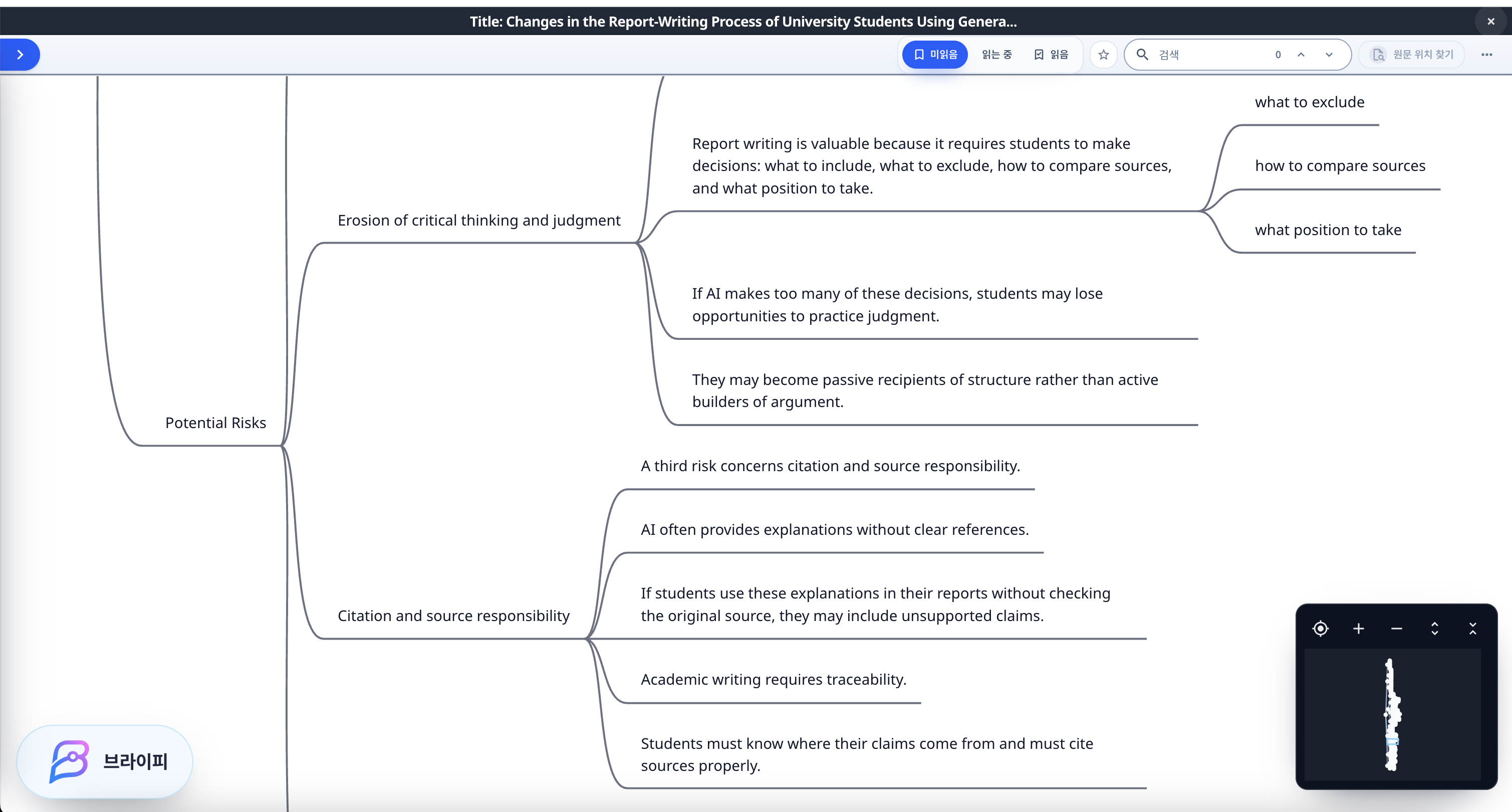
A Brify structure map can organize team materials by topic, section, evidence, and source. It helps turn scattered individual research into one submission structure.
Before a team meeting, reviewing the map can lead to better discussion than simply reporting progress.
Turning Materials Into a Submission-Ready Structure in Brify
The most important point in How to Organize Scattered Materials in a Team Assignment is that collecting materials and using them well are not the same thing. A report or assignment is not a list of sources. It needs to show how you understand the question, which claims you are making, and what evidence supports those claims.
In Brify, you can organize materials into a structure map with nodes such as assignment question, main claim, supporting source, citation point, your interpretation, outline candidate, and sentence ideas for the final report or presentation. This keeps an AI summary from becoming the final answer too quickly.
When you work with multiple sources, citations can get mixed together, similar ideas repeat, and the evidence you actually need may be missing. A structure map makes it easier to see which source supports which claim, where the gaps are, and what should be removed before you write.
When a Structure Map Helps Most
A structure map becomes especially useful when you have enough material but cannot build a report outline, when an AI summary is available but you cannot tell what came from the original source and what is your own interpretation, or when team project materials are scattered across messages, documents, and links.
It also helps when you are close to submission and suddenly need to find citations again. At that point, more summarization is usually not the answer. What you need is a clear connection between the assignment question, claims, evidence, and sources.
Pre-Submission Checklist
If you are working on organize team assignment materials today, check four things: does this material directly answer the assignment question, does each claim have evidence and a source, are the original summary and your interpretation separated, and can the structure be turned into a report outline or presentation flow?
If those four things are not visible, the material is not fully ready for submission yet. Turning it into a Brify structure map connects understanding, citation checking, outline building, and presentation preparation in one workflow.
Final Thoughts
Team material organization is not just combining files. Reorganize sources around topics and sections in Brify so the team can see one shared flow.