

How to Keep Sources and Citations While Summarizing Multiple Materials
When summarizing multiple materials, keep summaries, source locations, citation candidates, and your interpretation separated.
When you summarize multiple materials, everything may feel clear at first. A few days later, however, you may not remember which sentence came from which source, whether it can be cited, or whether it was your own interpretation. A summary without source tracking can weaken the reliability of the final assignment.
Why Sources Get Mixed When You Summarize Many Materials
When several sources discuss similar topics, their terms and claims start to repeat. If you only collect summaries, it becomes hard to know which idea came from which source.
AI summaries can make this even harder because different sources may be rewritten in a similar style.
What to Keep Next to Every Summary
Next to each summary, keep the title, author or organization, URL or file name, page or section, and the important sentence you checked. For web sources, do not save only the link. Save why the link matters.
This information also makes citation formatting much easier later. Source organization should happen during summarization, not only at the end.
Separate Citable Material From Background Notes
Not every summary is something you should cite. Some material only helps you understand the topic, while some can support a specific paragraph.
Mark notes as citation candidates, background reference, or needs verification. This makes final review much easier.
Separate Your Interpretation From the Original Source
Keep what the original source says separate from what you think it means. Without that distinction, you may accidentally present your interpretation as the source’s claim or treat the source’s idea as your own.
A simple split between source content and your interpretation reduces plagiarism risk and improves clarity.
Create a Source-Aware Material Map in Brify
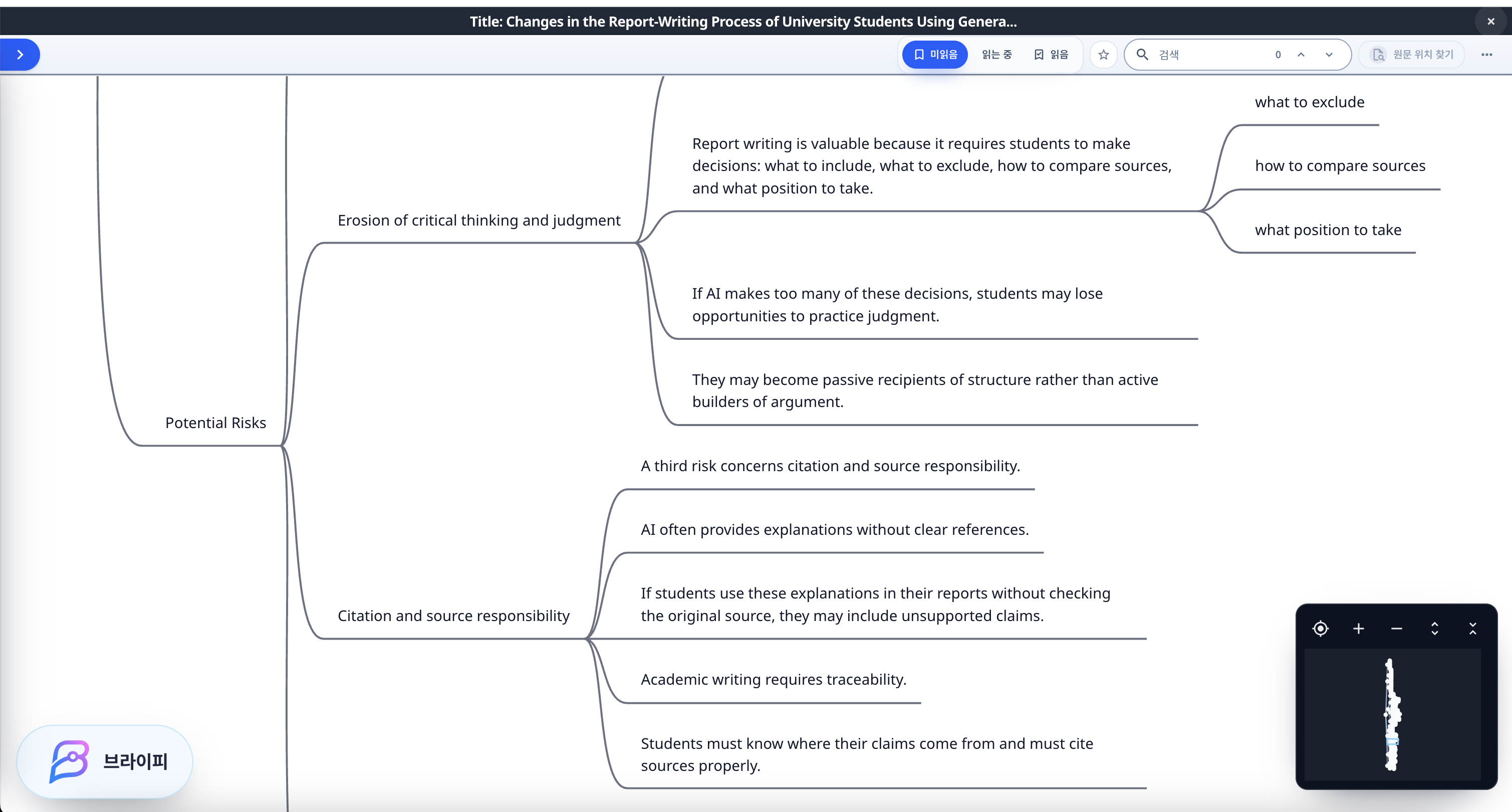
In Brify, each evidence node can include the source and citation point. Keeping summaries and sources in the same structure reduces time spent searching later.
You can also gather multiple sources under the same claim and compare which one provides the strongest evidence.
Turning Materials Into a Submission-Ready Structure in Brify
The most important point in How to Keep Sources and Citations While Summarizing Multiple Materials is that collecting materials and using them well are not the same thing. A report or assignment is not a list of sources. It needs to show how you understand the question, which claims you are making, and what evidence supports those claims.
In Brify, you can organize materials into a structure map with nodes such as assignment question, main claim, supporting source, citation point, your interpretation, outline candidate, and sentence ideas for the final report or presentation. This keeps an AI summary from becoming the final answer too quickly.
When you work with multiple sources, citations can get mixed together, similar ideas repeat, and the evidence you actually need may be missing. A structure map makes it easier to see which source supports which claim, where the gaps are, and what should be removed before you write.
When a Structure Map Helps Most
A structure map becomes especially useful when you have enough material but cannot build a report outline, when an AI summary is available but you cannot tell what came from the original source and what is your own interpretation, or when team project materials are scattered across messages, documents, and links.
It also helps when you are close to submission and suddenly need to find citations again. At that point, more summarization is usually not the answer. What you need is a clear connection between the assignment question, claims, evidence, and sources.
Pre-Submission Checklist
If you are working on summarize materials with sources today, check four things: does this material directly answer the assignment question, does each claim have evidence and a source, are the original summary and your interpretation separated, and can the structure be turned into a report outline or presentation flow?
If those four things are not visible, the material is not fully ready for submission yet. Turning it into a Brify structure map connects understanding, citation checking, outline building, and presentation preparation in one workflow.
Final Thoughts
If you lose sources while summarizing, the final stage becomes stressful. Use Brify to keep summary, source, and interpretation together from the beginning.